
Metal Roof vs. Asphalt Shingles: A Long Beach Homeowner’s Guide

Asphalt shingles often offer a lower upfront cost. Metal roofing offers different profiles and may be worth a larger initial investment for homeowners prioritizing long-term use. The better choice depends on the exact products, your roof’s condition, coastal exposure, installation scope, and the maintenance responsibilities you are comfortable taking on.

This guide helps you compare metal roofing and asphalt shingles before discussing a replacement for your Long Beach property. Use it to identify the differences that matter and ask for two clearly explained proposals rather than choosing by a material name alone.

RoofReplacementLongBeach.com is an informational roofing resource. It does not personally inspect roofs, provide estimates, sell roofing products, or perform roofing services.

This guide is educational only. It is not an inspection, product recommendation, estimate, warranty, or determination that a roofing system is suitable for your property.

Metal Roofing vs. Asphalt Shingles at a Glance

Start with the broad differences, then check the specific products and work proposed for your home.

Upfront cost: Asphalt shingle installations commonly have a lower initial price. A metal proposal may involve a larger investment; compare the complete installed scope before judging the difference.

Appearance: Asphalt shingles offer flat or layered shingle patterns. Metal is available as panels and as profiles resembling shingles, shakes, tile, or slate.

Service life: Metal is often considered for its potential for longer service. Actual roof performance depends on the product, assembly, installation, exposure, and maintenance; a warranty term is not a predicted replacement date.

Repairs: Ask how a damaged shingle, metal panel, fastening detail, or flashing would be assessed and repaired, including access and replacement-product availability.

Heat performance: Compare the proposed product and color’s documented surface ratings. Neither “metal” nor “asphalt” establishes a home’s energy savings.

Coastal exposure: Check the entire system, including metal components used with either covering. Ask about corrosion, compatible accessories, maintenance, and warranty exclusions for the property’s location.

The general upfront-cost distinction is discussed in GAF’s metal-versus-asphalt overview. It provides context, not a Long Beach price comparison or a performance promise for your roof.

First, Identify What You Are Comparing

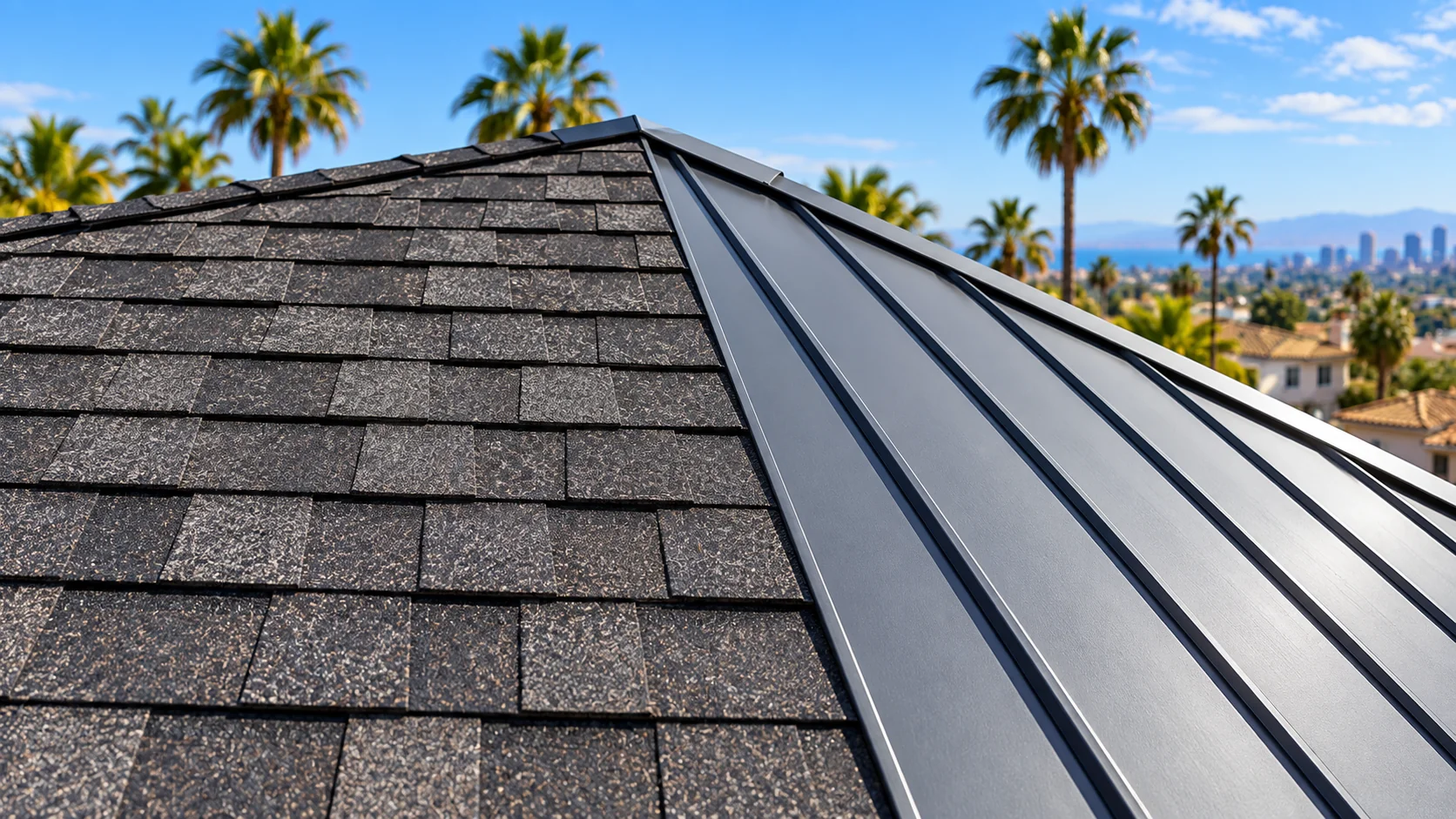
Illustrative side-by-side asphalt shingles and metal roof panels

Illustrative asphalt-shingle and metal-panel comparison; not a documented local project.

Asphalt Shingle Options

An asphalt proposal should identify the manufacturer, product line, profile, and color. Traditional 3-tab shingles and laminated architectural shingles have different appearances; premium or designer offerings add further product choices within the asphalt family. ARMA’s roofing-types overview explains the distinction between strip and laminated shingles.

“Architectural shingles” is not a complete specification. Ask what underlayment, starter and ridge products, flashing, ventilation, and installation requirements accompany the proposed shingles.

Metal Panels and Metal Shingles

Metal roofing does not always mean long, exposed panels. The Metal Roofing Alliance’s style overview shows standing-seam panels and shingle-shaped profiles, among other configurations.

A useful proposal identifies the base metal, profile, finish, fastening arrangement, and associated components. A standing-seam panel proposal and a metal-shingle proposal should not be treated as interchangeable just because both use metal.

Compare the options actually available for your property. Ask to see samples of the specified products rather than relying on a photograph of a different profile, finish, or color.

Metal Roof vs. Shingles Cost: Compare the Same Work

The difference between two estimates is not necessarily the price of the visible covering. It may also reflect different measurements, tear-off assumptions, deck preparation, underlayment, flashing, ventilation, access, disposal, or permit handling.

To compare metal roof cost with shingle roof cost, ask both providers to describe the same roof sections and explain any differences in the underlying work. Confirm whether prices refer to materials alone or a complete installation. If a price is expressed per roofing square, one square means 100 square feet of roof area; it does not describe everything included in the price.

Useful questions include:

1

Are both proposals based on the same roof area, waste assumptions, and existing layers?

2

Is full tear-off included, and what happens if the deck needs repairs?

3

Which accessories, flashing details, ventilation changes, permits, and disposal charges are included?

4

What is excluded, and how will additional work be priced and approved?

If the metal option costs more, ask the provider to explain what accounts for the difference. Consider whether its appearance, proposed system, maintenance obligations, and expected use of the property justify that additional spending for you.

Do not assume a more expensive roof will pay for itself through resale, avoided replacements, or lower utility bills. Those outcomes need evidence and depend on circumstances beyond the covering alone. This guide does not provide local price ranges or project-specific estimates.

Compare Service-Life Expectations and Written Warranties

It is reasonable to ask how long each proposed system is expected to serve the property. Ask what supports that expectation and which installation, exposure, ventilation, and maintenance conditions it assumes. A broad category comparison cannot predict the remaining life of an existing roof or the service life of a new one.

Read warranty coverage separately. A material warranty, finish warranty, and workmanship warranty may address different issues. The number of years on a document does not tell you whether labor, leak repairs, removal, replacement, or all roof components are covered.

For either proposal, ask who provides each warranty, whether registration or a particular system is required, what exclusions apply, and what documents you will receive. Also ask about transferability if a future property sale is part of your planning. Get the actual terms before relying on a summary in an estimate.

Maintenance and Repair: What Would Ownership Involve?

Questions for an Asphalt Shingle Proposal

Ask how future missing, cracked, lifted, or damaged shingles would be evaluated. A repair discussion should address the surrounding roof’s condition, whether a matching product is available, and whether the affected area can be repaired without disrupting brittle adjacent shingles.

Ask what inspections or maintenance the product documents call for, who should perform them, and how flashing, roof penetrations, gutters, and debris concerns will be handled. Replacing the visible covering does not remove the need to maintain the rest of the roof system.

Questions for a Metal Roofing Proposal

Ask which checks apply to the particular panels or shingles, finish, seams, fasteners, sealants, and accessories. Request the manufacturer’s maintenance instructions and ask what records should be kept, especially if exposure-related conditions appear in the warranty.

Find out how localized damage, a finish concern, or a future roof penetration would be handled. Ask whether a repair could involve more than the visibly affected piece and whether matching panels, profiles, or finishes are likely to require special ordering. Neither proposal should be evaluated as a maintenance-free purchase.

Heat, Color, and Cool-Roof Questions

A material name or light appearance is not enough to establish heat performance. The Cool Roof Rating Council’s homeowner guidance explains solar reflectance and thermal emittance, the surface properties used in its ratings. Ask for the ratings associated with the exact product and color in each proposal.

Keep roof-surface ratings separate from household energy savings. Insulation, ventilation, the building, and how it is cooled also belong in the conversation. Ask what any claimed savings are based on; do not treat a product rating as a promised reduction in your bill.

California’s 2025 Energy Code applies to permit applications submitted on or after January 1, 2026. Ask which requirements apply to your replacement project and who will document them. This guide does not assign a climate zone, product threshold, or compliance outcome to your property.

Coastal Exposure and Weather in Long Beach

If your property is exposed to coastal air or saltwater conditions, make that part of the material discussion. The Metal Roofing Alliance’s marine-environment guidance identifies salt exposure as a corrosion concern. Its general guidance does not establish that any particular metal product is appropriate for your address.

For metal roofing, ask about the base metal, protective finish, cut edges, fasteners, adjoining materials, and the written exposure limits. For asphalt shingles, ask about the flashing, vents, fasteners, and other metal accessories as well as the shingles. A roof with asphalt shingles still includes components that deserve exposure-specific attention.

Ask each provider:

1

How does this proposal address the property’s actual exposure and roof details?

2

Which product or warranty conditions apply near saltwater, and where are they documented?

3

What inspection, cleaning, or maintenance responsibilities would I have?

For wind, impact, or fire questions, request the applicable product and assembly documentation. Do not assume a material label alone proves performance, insurance eligibility, or compliance. Do not climb onto a roof to inspect corrosion or damage yourself.

Roof Shape, Noise, Solar, and Future Changes

Describe different roof sections before comparing coverings. A pitched main roof, low-slope addition, patio covering, or garage may need different evaluations and connection details. Ask the provider to confirm measured slope, deck condition, support, drainage, and the proposed assembly for each section.

If rain noise is a concern, ask about the complete assembly—including the deck, insulation, and interior spaces—rather than assuming a metal roof will sound like an uncovered metal shed. Request an explanation tied to the proposed installation; this guide does not promise a particular indoor sound level.

Mention existing or planned solar panels, skylights, vents, or other equipment. Ask who will handle removal, reinstallation, attachment details, future access, and any effect on warranties. Compare those responsibilities in both proposals before assuming they are included.

If an overlay is suggested, ask how existing layers, concealed conditions, product requirements, and applicable rules were evaluated. Do not assume that avoiding tear-off is suitable simply because one proposal offers it.

A Checklist for Comparing Two Roofing Proposals

Use the same questions for both options. Mark unclear items as questions to resolve before making a material decision.

1

Product: What manufacturer, product line, profile, color, and supporting documents are specified?

2

Roof sections: Which areas are included, and what property assessment supports the proposed system?

3

Complete scope: What removal, deck work, underlayment, flashing, ventilation, transitions, and accessories are included?

4

Total cost: Are allowances, exclusions, permits, disposal, additional-work pricing, and approval procedures explained?

5

Ownership: What maintenance, repair access, replacement-product, and future-equipment responsibilities should I expect?

6

Written protection: What do the material, finish, and workmanship warranties actually cover and exclude?

Long Beach’s Permit Center provides official permit resources. Ask who will confirm applicable permit and inspection requirements and whether an HOA, historic designation, coastal-zone question, or other property condition needs review. These are items to check for the property, not requirements this guide determines for every roof.

If the proposals answer different questions or cover different work, request clarification before comparing their totals. A useful material decision starts with understanding what you would be buying.

Prepare Your Metal-Versus-Asphalt Question

You do not need to choose a product before asking a question. Start with the property ZIP code or neighborhood, building type, known roof material, approximate age if known, and the reason you are considering replacement. Mention different roof sections and the priorities you want to compare.

For example:

“I own a one-story home in Long Beach with a shingle main roof and a low-slope rear addition. I am comparing architectural asphalt shingles with a metal option. I would like to understand the difference in the installed scope, coastal-exposure requirements, maintenance, and warranties. I am not sure which system would be appropriate for the addition.”

This is an illustrative inquiry, not an actual customer project. Use “not sure” for unknown details. If you already have safely taken photos or written estimates, mention their availability and check the contact channel’s sharing instructions before sending files or personal documents.

Metal Roof vs. Asphalt Shingles FAQs

Is a Metal Roof Better Than Asphalt Shingles?

Neither material is automatically better for every home. Compare suitable products for your roof sections, complete installation scope, upfront spending, appearance, exposure, maintenance, and written warranty terms. A provider should explain why the proposed system fits the property.

How Much Is a Metal Roof Compared to Shingles?

Metal roofing commonly has a higher initial installed cost, but the difference depends on the specific products and work included. Compare two estimates for the same roof sections and clarify tear-off, decking, accessories, permits, and exclusions. A material-only number is not a complete replacement price.

Does Metal Roofing Always Last Longer?

Metal is often considered for its potential for longer service, but no material name guarantees an outcome. Ask what service-life expectation applies to the proposed product and what installation, exposure, and maintenance assumptions support it. Review warranty coverage separately.

Can I Choose a Metal Roof That Looks Like Shingles?

Yes. Metal roofing includes shingle-shaped profiles as well as panels. Ask to see the exact product, finish, and installation details. A shingle-like appearance does not make it the same material or system as asphalt shingles.

Is Asphalt or Metal Better Near the Coast?

The property’s exposure and the complete system need evaluation. Ask about metal and finish selection, compatible accessories, corrosion-related exclusions, and maintenance. Neither the city name nor a general “coastal” product description establishes suitability for your address.

Will a Metal Roof Make My Home Cooler or Noisier?

Neither result can be determined from the covering alone. For heat questions, compare documented product ratings and discuss the building’s insulation and ventilation. For noise, ask about the proposed roof assembly and interior conditions. Avoid relying on blanket claims about energy bills or indoor sound.

Can the Same Material Cover My Main Roof and Low-Slope Addition?

Do not assume so. Ask the provider to assess each section’s slope, condition, drainage, and product requirements, then explain how the systems would connect. A proposal should identify any section needing a different approach.

Does This Website Recommend Products or Provide Roofing Estimates?

No. RoofReplacementLongBeach.com provides educational information. It does not inspect roofs, select products for your property, sell materials, provide estimates, or perform roofing work. An inquiry does not guarantee a provider connection or project outcome.

Ask About Your Roofing Material Comparison

Explain what you are deciding between and what matters most: upfront spending, appearance, maintenance, coastal exposure, or the details of two proposals. Start with what you know; you do not need to diagnose the roof or settle on a product first.

Use the existing contact page to review the available inquiry method and its privacy and consent information before submitting personal details.

RoofReplacementLongBeach.com does not personally perform roofing services. Submitting an inquiry does not guarantee service availability, a provider match, a quote, an inspection, or any project outcome.

A website form is not an emergency response channel. For urgent water intrusion or active danger, contact appropriate property professionals, qualified providers, or emergency services directly.