
Roof Shingle Types and Materials

Roofing names can make a comparison harder than it needs to be. Architectural shingles are a type of asphalt shingle. Metal roofing can come as shingles or panels. Tile, slate, and low-slope membranes belong to other roofing categories, even when a product is made to resemble a different material.

This guide helps Long Beach homeowners sort those options before discussing a replacement. Learn what the names mean, identify the questions that matter for your roof, and compare the proposed work alongside the appearance.

RoofReplacementLongBeach.com provides informational roofing resources. It does not personally inspect roofs, determine material suitability, sell roofing products, or perform roofing services.

This content is educational and is not a contractor recommendation, quote, inspection, warranty, or guarantee. Material suitability should be confirmed by a qualified roofing professional.

Understand the Names Before Comparing Roof Shingle Types

Start by separating three things: the material, the product style, and the complete roof system. A proposal that says “architectural” describes a style; it does not identify every component or confirm what work is included.

Use these distinctions when discussing types of roof shingles:

1

Material: what the covering is made from, such as asphalt, metal, wood, clay, or concrete.

2

Style or profile: how a product looks, such as a flat repeating pattern, a layered profile, or a shake-like appearance.

3

Roof system: the covering together with the supporting layers, connections, drainage details, and other work specified for the project.

Ask for both the material category and the exact product name. “Slate-look roofing” may describe an appearance rather than natural slate. “Metal roof” does not tell you whether the proposal uses shingles or panels.

The National Roofing Contractors Association's material overview distinguishes several of these categories. Its descriptions are a starting point for research, not a recommendation for your property.

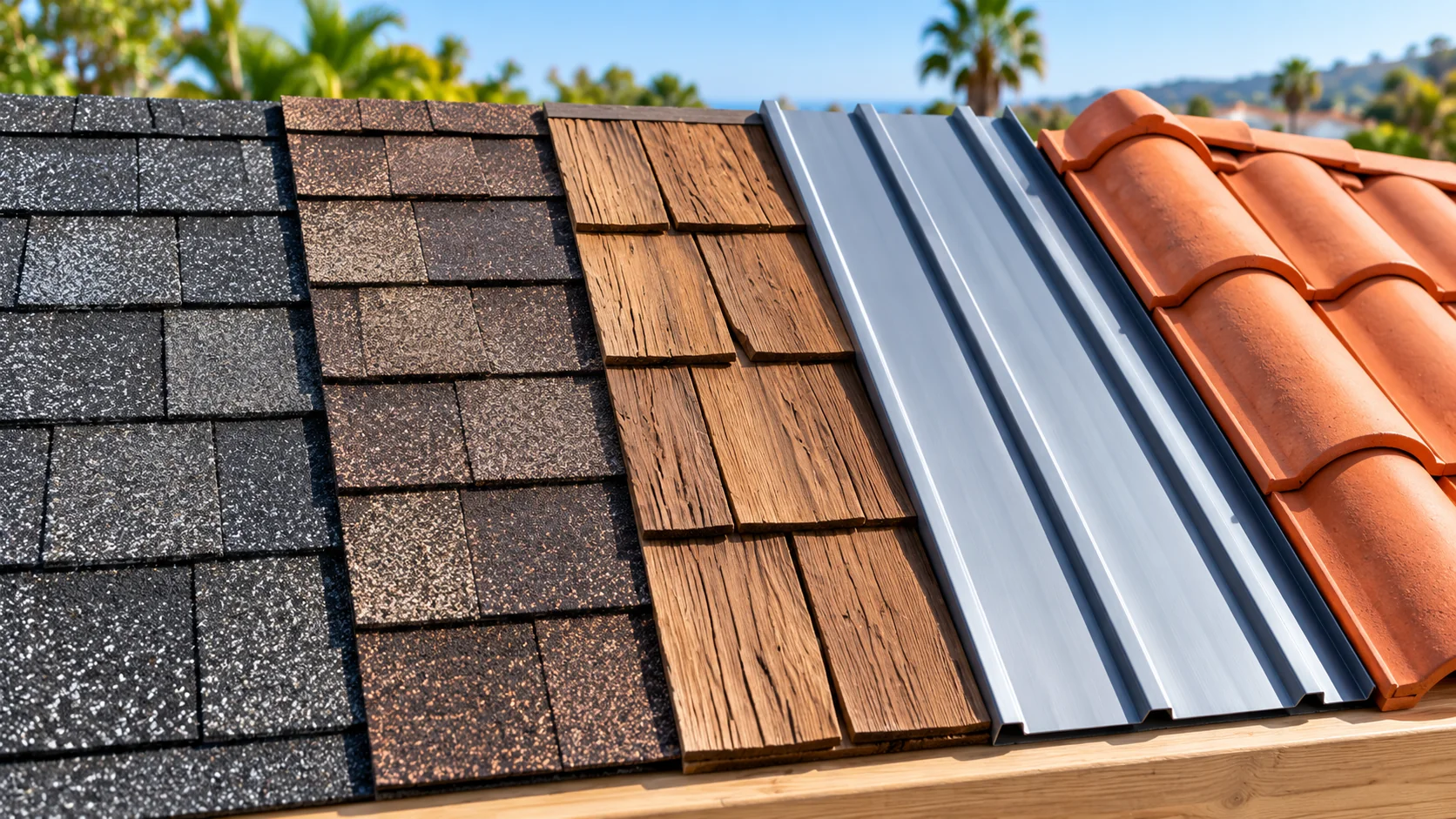
Illustrative roofing samples with asphalt shingles, wood, metal and tile

Illustrative material samples; compare the exact product and roof system.

Compare Roofing Material Categories

Use the summaries below to decide what you want a provider to explain. They do not establish which material your building can use, whether a product is locally available, or what an installation will cost.

Asphalt Shingles: 3-Tab, Architectural, and Designer Styles

Asphalt shingles include strip shingles, such as traditional 3-tab products, and laminated products often called architectural or dimensional shingles. Premium or designer labels describe additional product offerings rather than a separate material family. ARMA's overview of asphalt roofing types explains the strip-versus-laminated distinction.

If a proposal offers architectural asphalt shingles, ask which manufacturer, product line, and color are included. If it offers a designer option, ask what changes besides the appearance. Do not treat a category label as proof of a particular rating, warranty, or service life.

Questions to bring:

•

Which asphalt shingle products are being considered for the actual roof sections?

•

What supporting materials and ventilation work are included with each option?

•

What documents explain the proposed product and its installation requirements?

Metal Shingles and Metal Panels

Metal roofing includes both shingle-shaped products and panel systems. The Metal Roofing Alliance's style overview illustrates these different configurations. Some metal shingles imitate the look of other roof coverings. The word “metal” alone does not identify the proposed configuration.

Ask the provider to identify the metal, profile, finish, and fastening approach in the proposal. If coastal exposure is a concern, ask how the proposed components, coatings, and warranty conditions address the property's location. Do not assume every metal product has the same requirements.

Questions to bring:

•

Does this proposal use metal shingles or panels, and why is that configuration being considered?

•

How will transitions, penetrations, fasteners, and different adjoining materials be detailed?

•

What should I understand about maintenance, expansion, sound, and any exposure-related warranty exclusions?

Clay and Concrete Tile

Clay and concrete are distinct tile materials. Tile profiles can also vary. When a project changes to tile, the building's ability to support the proposed load needs verification.

Ask about the particular product and the work underneath it. Replacing a visible tile and replacing an entire tile-roof assembly are different scopes; a proposal should make the intended work clear.

Questions to bring:

•

Who will assess whether the structure is appropriate for the proposed tile and assembly?

•

What underlayment, flashing, attachment, and transition details are included?

•

How would future access, damaged tiles, and maintenance be handled?

Wood Shingles and Shakes

Wood shingles and shakes are wood roof-covering categories with different surface characteristics. Their natural appearance should be considered separately from product approvals and applicable fire requirements.

If you are interested in wood, ask a qualified provider to identify the exact product and explain what can be considered for your property. Do not assume a wood product is allowed or appropriate because you have seen a similar roof nearby.

Questions to bring:

•

Which product and tested assembly would be proposed, and what requirements need confirmation?

•

Are there property-specific fire, permit, HOA, or other restrictions to resolve?

•

What maintenance and future repair responsibilities should I understand before choosing it?

Natural Slate and Synthetic Alternatives

Natural slate is a stone roof covering. Synthetic products may imitate slate or wood while having different material properties. Appearance alone does not establish equivalence.

Ask the provider to distinguish natural material from a look-alike product in writing. If you are changing coverings, ask who will evaluate the proposed assembly, structural questions, and installation requirements.

Questions to bring:

•

Is the product natural slate, a synthetic alternative, or another material with a similar profile?

•

Which product-specific documents support the proposal?

•

What should I know about availability, replacement pieces, maintenance access, and the provider's relevant installation experience?

Rolled Roofing and Low-Slope Membrane Systems

Rolled roofing and membrane products belong in a different comparison from individual shingle styles. For a low-slope addition or flat-looking roof section, ask the provider to identify the proposed system rather than treating every roof surface as a shingle application.

An asphalt roll product, a modified-bitumen system, and a single-ply membrane are not interchangeable descriptions. ARMA's roofing overview also discusses modified-bitumen roofing; ask for the specific product and assembly in any proposal.

Questions to bring:

•

What roof measurements and slope information support the proposed system?

•

How will seams, penetrations, edges, and drainage be addressed?

•

How will this section connect to a shingle, tile, or metal section elsewhere on the building?

Start With the Roof's Shape and Existing Conditions

Before narrowing the shortlist, describe the building. A pitched main roof, a lower-slope rear addition, and an attached garage may need separate explanations. Tell the provider what you know and leave unknown details as “not sure.”

Ask how the proposed materials relate to each roof section's measured slope, support, deck condition, existing layers, drainage, and transitions. Request an explanation of anything that still needs investigation before a recommendation or price can be finalized.

Keep observations separate from conclusions. A stain after rain is useful information, but it does not establish where water entered or which material should replace the existing roof. You can ask about repair and replacement options before choosing a covering.

Do not climb onto the roof to identify materials or take measurements. Safe ground-level observations, existing records, and a plain-language description are enough to start a general question.

Compare Complete Proposals Alongside Material Choices

Two options are easier to assess when the proposal separates the covering from the rest of the work. Ask what changes in removal, deck preparation, underlayment, flashing, ventilation, drainage, permit handling, cleanup, and closeout documents when the material changes.

Avoid comparing a shingle-only material price with the total price of an installed roof. Ask each provider to identify the roof sections included, assumptions about existing layers, concealed-condition allowances, exclusions, and the process for approving additional work.

Keep budget questions specific: “What changes in the written scope between these two material options?” gives you more to compare than a claim that one category is always cheaper or better value. This guide does not provide local prices or project-specific estimates.

Long Beach Questions That Can Affect Your Shortlist

Use the property's actual circumstances to frame the conversation. Ask whether coastal exposure, nearby obstructions, roof access, HOA documents, a historic designation, or other property-specific factors need to be considered. A Long Beach neighborhood name does not establish an approval or material recommendation.

The City of Long Beach Permit Center provides official permit resources. Ask who will confirm applicable requirements, obtain any required permit, arrange inspections, and provide the resulting documents.

California's 2025 Energy Code applies to permit applications submitted on or after January 1, 2026. Ask whether energy or cool-roof requirements affect the proposed replacement and the particular product. This page does not assign a climate zone, reflectance threshold, or compliance outcome to your property.

If someone describes a product as “cool,” ask which documentation supports that description and what is relevant to your scope. Do not select a product solely because of its material name, color, or a broad efficiency promise.

Check Appearance Against the Exact Product

Bring a few visual preferences, then ask to see the proposed product's sample and specifications. Confirm whether an example photograph shows the same material, profile, and color. A slate-like or shake-like appearance does not tell you what a roof covering is made from.

Keep product claims tied to documents. Ask which ratings apply to the proposed product or assembly, which components and installation conditions are involved, and what the actual warranty covers or excludes. Ask separately about any workmanship warranty and who would provide it.

A manufacturer's reference or an attractive example does not mean this website endorses a product or verifies a provider's proposal. Take unresolved questions back to the provider before agreeing to a material selection.

A Practical Checklist for Comparing Your Options

For each option you are seriously considering, ask for answers to the same questions:

1

Identity: What is the exact material, manufacturer, product line, profile, and color?

2

Fit: Which roof sections are included, and what assessment supports the proposal?

3

Complete scope: What covering, supporting layers, connections, ventilation, and drainage work are included?

4

Requirements: Who will confirm product instructions, permits, energy requirements, and any property-specific restrictions?

5

Ownership costs: What maintenance, access, future repair, and replacement-piece questions should I plan for?

6

Written terms: What is excluded, how are changes approved, and which warranty and closeout documents will I receive?

If one proposal leaves an item unanswered, ask for clarification before treating it as equivalent to another. You do not need to become a roofing specialist; the goal is to understand what each option actually includes.

Prepare a Useful Roofing Material Question

Share the property ZIP code or neighborhood, building type, known existing covering, any different roof sections, and the decision you are trying to make. Mention access constraints or property approvals you already know about. Exact measurements and an already selected product are not necessary for an initial question.

For example:

“I own a Long Beach home with a pitched main roof and a lower-slope addition. I am researching replacement materials and have not chosen a product. I would like to understand which options need to be evaluated for each section and what would change in the written scope between them.”

This is an illustrative message, not an actual customer project. Use “not sure” for unknown details. If you have photos taken safely from the ground or a normal interior location, mention that they are available and check how they can be shared through a confirmed contact channel.

Roof Shingle Types and Materials FAQs

Which Roofing Material Is Best for a Long Beach Home?

There is no universal choice established by the city name. Ask a qualified provider to assess the roof sections and explain the proposed products, complete assemblies, applicable requirements, maintenance questions, and written terms.

What Are the Main Types of Roofing Shingles?

Shingle categories include asphalt, metal, and wood. Within asphalt, names such as 3-tab and architectural describe different styles. Tile, natural slate, synthetic alternatives, and low-slope membranes should be identified separately in a material comparison. Ask which exact products could be considered for your roof sections.

Does Metal Roofing Mean Long Panels?

Not always. Metal shingles and metal panels are different product configurations. Ask which one is proposed and how it would be detailed for the building; do not compare proposals using the material name alone.

Is Metal Roofing Automatically Better Than Asphalt Shingles?

No material label settles the decision. Ask how the particular proposals compare for your roof's conditions, the complete work included, maintenance, documented product features, and your priorities. A general comparison is not a property-specific recommendation.

Can One Material Cover Both the Main Roof and an Addition?

Do not assume so. Ask the provider to evaluate the sections separately, including their slopes and the proposed connection. A flat-looking or low-slope area needs its own system explanation before it is included in a shingle proposal.

Is a Slate-Look Product the Same as Natural Slate?

No. A look describes appearance; ask what the product is made from. Compare the actual specifications, support and installation questions, maintenance guidance, and warranty terms rather than assuming matching appearances mean matching properties.

Does This Website Sell Shingles or Choose a Material for Me?

No. RoofReplacementLongBeach.com provides educational information. It does not sell roofing materials, inspect the building, determine product suitability, or guarantee a provider's recommendation. A submitted question does not reserve products or roofing work.

Ask About Your Roofing Material Options

Start with what you know about the property and explain the materials or questions you are comparing. Review the existing contact page's inquiry method and consent information before submitting personal details.

RoofReplacementLongBeach.com does not personally perform roofing services. Submitting an inquiry does not guarantee service availability, a provider match, a quote, an inspection, or any project outcome.

A website form is not an emergency response channel. For urgent water intrusion or active danger, contact appropriate property professionals, qualified providers, or emergency services directly.